Salix Notes
This document consists of a brief set of primary talking points extracted from Nathan's introductory document on the Salix vs LLM paradigm comparisons. In addition, I've added a few brief interpretive points of my own as I'm working towards understanding the Salix system. See the "Interpretations" section.
Contents
1. Some basic talking points
Note that the points itemized in this section are somewhat detached from each other but can be used individually during a conversation or presentation.
-
Salix is best understood as the first serious attempt to give software the accumulation properties of an institution with the fidelity properties of a machine.
-
The traditional software lifecycle ends, for systems built in the traditional way.
- No more versions, rewrites, migrations, or restarts — one continuous living system, tended rather than replaced.
- Institutional memory without decay; the operator's relationship shifts from engineering toward husbandry.
-
Context is where Salix departs from everything else, and it is the single most important concept in the framework.
-
Every piece of work in a Salix system carries a context, and a context is two things stapled together:
- Subject — what this work is about: a representation of the concern to be addressed.
- Basic — why: a reference to the preceding context whose work surfaced this need.
-
Context for Salix can also be defined as a structural chain of "why", inherited and queryable. This chain should be viewed as inheriting work rather than receiving it.
-
In addition, Salix is a live, self-rewiring system of observe then react behaviours.
-
In the LLM world, context is cargo — the text you managed to fit into this call's briefing pack, assembled fresh every time by the harness ("context engineering" is the craft of "packing" well).
-
In the LLM paradigm, relevance is recomputed per call (retrieval, ranking, packing).
-
In Salix, relevance is inherited by position — work is born knowing what it's about, because it hangs off the chain that made it necessary.
-
For a task performed once, the LLM wins outright: no setup, no teaching, near-zero marginal effort to start.
-
For a task performed ten thousand times, the shapes invert.
-
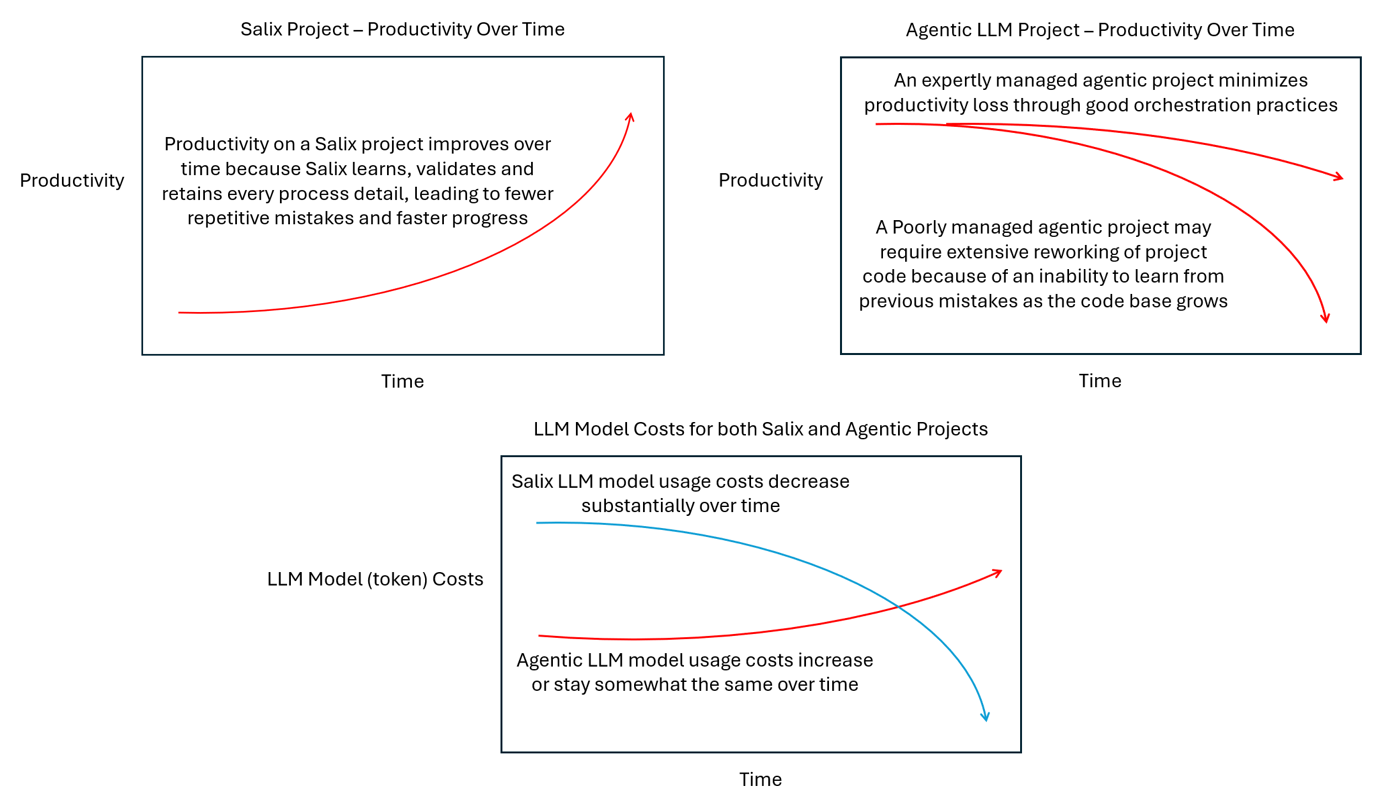
The LLM stack pays full price every time — the ten-thousandth "invoice categorisation" (for example) costs the same tokens, latency, and attention-rent as the first, and the payments build no equity.
-
In Salix, the first occurrence might engage the consultant (expensive), the hundredth a distilled nano-model (cheap), the ten-thousandth a compiled pathway (approximately free) — with the "spend" converted into "owned structure" along the way.
-
One paradigm (LLM) rents its competence in perpetuity.
-
The other paradigm (Salix) amortises early "spend" into continuously building "capital."
2. Interpretations
(Initial brief thoughts from Jim)
As a student of the philosophy of science for most of my life, one of the first things that seemed obvious to me when I started working with LLMs, was that LLM text responses are essentially hypotheses. As Nathan rightly pointed out, an LLM "produces a plausible explanation the same way it produces everything else: by predicting what a good explanation would look like."
LLMs are particularly good at identifying surface level creative hypotheses but not so good at generating "correlations" (statistical associations) or "causal descriptions" (explanatory relationships between real-world objects).
As with human scientific research, the path from hypothesis (educated conjecture) to provisional theory can be convoluted and indirect, however what matters is the direction of the process. Human knowledge is accumulated over time but it's not a straight line by any means although the overall direction is upward.
What makes Salix unique is that unlike LLMs, it focuses on the stepwise accretion of knowledge capital over time, building a better system by utilizing many of the elements of scientific methodology.
3. Graphs